I’ve been leading a software development team at the Centre for Collective Intelligence at Nesta for a couple of years now, and I’m lucky enough to work with, and have worked with, some brilliant people. Amongst the things we’re good at is the process of designing and running deliberative workshops.
Deliberation and polling are both collective intelligence techniques and, together, they offer rich insights into what people want (and more importantly why).
There are many forms of deliberation, and it’s a bit of an overloaded term. For instance, there are online processes such as free-text statement voting (of which the most famous example is pol.is), or forum tools that allow people to start threads and reply to each others comments.
Our workshops deliver conversational deliberation. That’s people talking together, explaining how they feel and discussing the issues that affect them. The closest established research technique might be a focus group.
We poll during our workshops which, as you’d expect, tells you how people feel about the policies and products we’re testing. The beauty of mixing polls with deliberation is that our researchers can dig into “the why”. Asking people to talk it through with each other creates a space for insightful conversations. From that, we can learn why people feel the way they do about policies and products, and what’s important to them.
Because we’re often asking people to discuss complex issues, we also deliver rich stimulus in the form of narrated videos, animations, and talking heads, informing and educating with relatable characters and scenarios. This gives people knowledge and time to respond, so they can give a considered opinion, rather than an instinctive reaction.
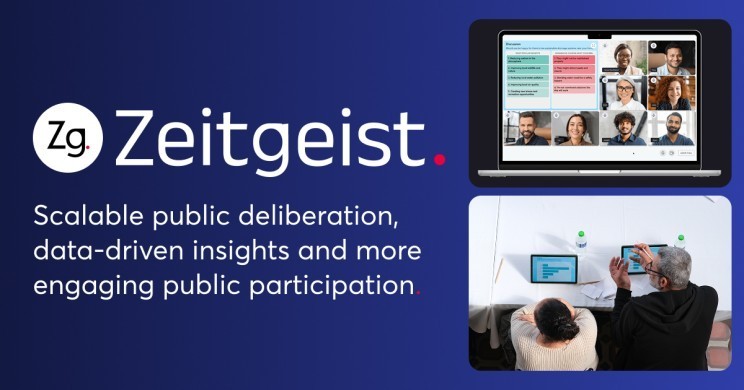
To allow us to scale this process from a few dozen groups to thousands of participants, we developed Zeitgeist. It’s a tool that allows us to run workshops consistently with a rich experience that integrates videos, polling, and the ability to capture deliberation transcripts for analysis.
Meeting people where they are is important, and Zeitgeist allows us to run workshops in-person or remotely, with the same content and the same experience every time for every participant. This means that we can scale quickly with remote participants, but still meet the needs of those with technical and accessibility issues who would much rather come to their local library.
Deliberations are at the heart of the process, and where we find the richest insights. Because we can link our participants opinions to their polling choices, we can start to answer questions like “Why did people feel so strongly about the policy?”, or “What could we do to make this change welcome?”
We’ve been working with local government and broader agencies to develop engagements that help them to understand what people want and need, as well as larger, more central government groups.
We also delivered The Situation Room, a series of workshops about coastal erosion, flooding, and water management with the Catchment to Coast programme. Focussed in Southend, we worked with hundreds of local residents to draw up a set of priorities for policies to manage the environment around them.
Over the course of our time refining and optimising deliberative workshops, we’ve tackled a wide range of issues and using Zeitgeist we can deliver a seamless experience for our participants. Instead of bouncing between video calls, slide decks, polling apps, expert witnesses and videos Zeitgeist offers a simple interface that delivers content and interactive elements as they’re needed.
I’ll be developing a series of more technical articles reflecting on that process, including some of the technical obstacles to scaling and the solutions we’ve selected.
Interested? We can help you
Find out more about how Zeitgeist and deliberative workshops can help you make the best decisions.